Let me first point out that, as much as I find the overindulgence in food in Michelin-starred restaurants stupid, I also hate fast food. You know, when you get a centimeter-long steak decorated with grass and I don’t know what else. Or you get a greasy patty that you eat standing up while rushing back to work, where your boss is already looking at his watch to see how long you’ve been at lunch.
There’s also the slow food movement, which is supposed to be a sustainable alternative to fast food. Oh well…
Anyway, when I was in New York last September, I decided to check out hamburgers, despite my reservations. Of course, I’ve eaten hamburgers before—after all, you can get them pretty much all over the world. Although, I do have the impression that the fashion for hamburgers filled with just about anything is slowly dying down.
Where does the hamburger come from? The first mention is from 1758, where it appears in a cookbook as “Hamburgh sausage,” suggesting that it should be served “roasted, with toasted bread under it.” A similar snack was also popular in Hamburg under the name “Rundstück warm” (“bread roll warm”) in 1869 or earlier, and was supposedly eaten by emigrants on their way to America. And from here, you get the probable connection to the name hamburger. It then evolved as ham+burger, although without any actual ham. And today, in most cases, it is simply called a burger.
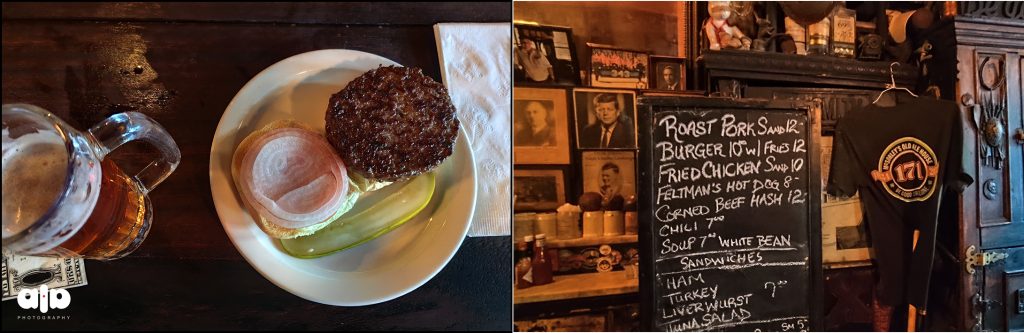
Classic, not to say old-fashioned, the burger consists of fillings—usually a patty of pan-fried or grilled ground meat, typically beef—placed inside a sliced bun, sesame seed bun, or bread roll. These patties are often served with lettuce, tomato, onion, pickles, bacon, or chilis, all together in the bun. A burger with the patty topped with cheese is called a cheeseburger. At the famous Irish pub McSorley’s Old Ale House on 7th Street, the bun is stuffed only with a patty, raw onion, and a pickle.
But let’s leave that to other researchers of burger history. It is not even known who created it first in America, thus creating another American legend.
On some website, I found information that 7th Street Burger is on the list of the ten best in the city. Well, there are plenty of such lists. But since I lived on the neighboring 6th Street, I went to check this place out.
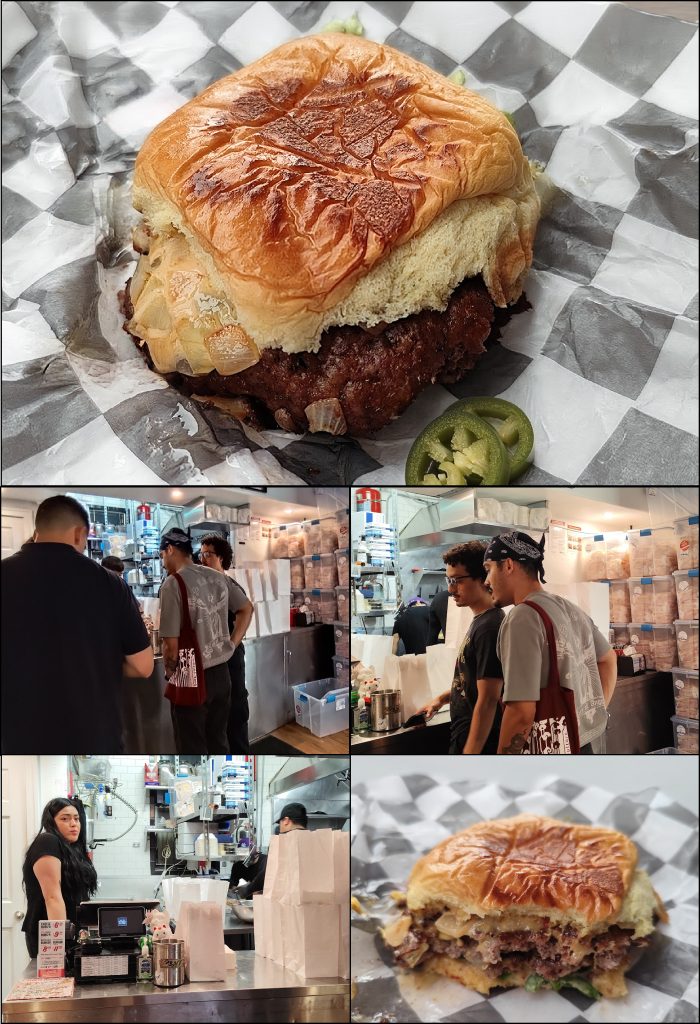
At first glance, the place is quite unassuming. A small hole in the wall where you stand in line and order. The guy asks me if I want a double. Of course. And put that jalapeno pepper on top.
Since you have to say your name so they don’t mix up the orders, I always try to spell it: B-R-A-N-E. My name means nothing to them and only a few can actually pronounce it. To paraphrase Johnny Cash:
And if I ever change my name, I think I’m gonna name me
Bill or George! Anything but Sue! (Brane)
You step out onto the street and wait for it to be made for you. The staff and guests are watching me suspiciously. Mostly young people of Hispanic appearance. Among them, I almost look like their father—years older, with long white hair. I don’t wait long for my burger to be ready, though.
There are two or three tables on the sidewalk. Since one is free, I sit down and examine what I got. Visually, completely correct. What about the taste? I admit, it’s one of the best burgers. For my taste, there could have been a little more jalapeno. The bun was too soft for my liking, almost fluffy. I’m used to a slightly more compact, Central European bread. But no big deal, the overall impression is exceptional.
As has been said many times—don’t let the appearance of the place fool you. Nor the youth of the staff. Whenever I return to New York, 7th Street Burger is definitely going on my list.
Fun facts:
The most expensive in the world: The legendary restaurant Serendipity 3 in New York City created the “Le Burger Extravagant.” It costs $295. The lavish meal features Japanese Wagyu beef, truffle butter, black truffles, caviar, and a 24k gold-fused toothpick encrusted with diamonds!
The world’s largest: The record is held by a burger from Germany (from 2017), which weighed an incredible 1,164 kilograms.