
One Man Band
Have you ever photographed something that seemed interesting to you at the time, and years later you realized that you had photographed a piece of history, a piece of urban legend, something that was left behind in another time?
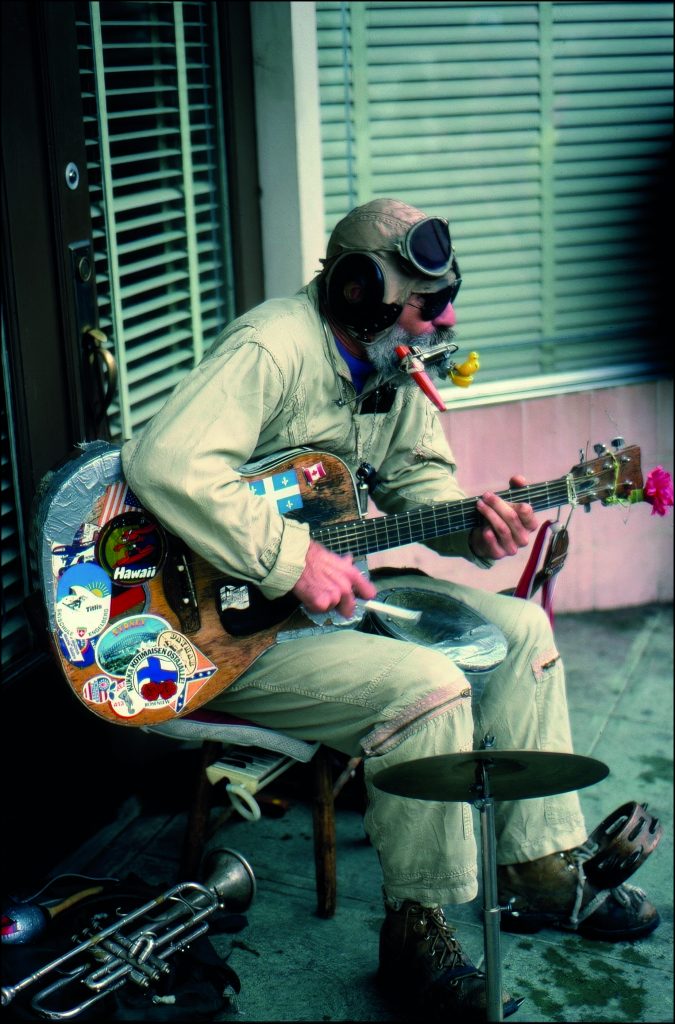
So I was walking through Fishermen’s Wharf in San Francisco back in June 2001. There I photographed a man without really knowing who I was looking at. At the time, he was just another one of those street characters that seem to belong to tourist postcards more than to real life. Only later did I realize that I had captured Uncle Ray Hechim — not just part of the scene, but one of its constants.
He was sitting on a simple wooden chair, as if he had always been there. Behind him, a door; to the side, a shop window with blinds — nothing that would draw attention on its own. And yet, everything that mattered was happening in and around him.
His body was an orchestra.
The guitar, covered in stickers, carried the marks of years and places. At the very top of its neck, a red carnation — almost certainly plastic — was tucked in, no less meaningful for that. Around him, instruments were arranged like planets around their axis: a cymbal, a drum between his knees, a trumpet by his foot, another wind instrument under the chair. Something rattled on his left leg whenever he moved. A harmonica rested close to his mouth. Every motion triggered a sound; every sound was part of a system that seemed to function without effort.
He wasn’t exactly playing music. It felt more like he was running it.
And then there was the way he was dressed — as if he didn’t quite belong to the time he was sitting in. A vintage pilot’s uniform, a soft helmet, dark goggles. Like someone who had missed a flight — or arrived from another decade and decided to stay.
There is no one else in the photograph. No one entering the frame, no one leaving it. As if, for that brief moment, the world had narrowed down to one man and his improvised orchestra. Maybe that is why the image feels more like a document today than a tourist snapshot.
At the time, I didn’t know I was photographing something that would slowly disappear.
Fisherman’s Wharf is different now. More polished, more predictable, more like its own postcards. People like Uncle Ray Hechim belonged to a time when cities still allowed for more randomness. When you could come across someone who had built an entire world around himself — and shared it, briefly, with whoever happened to pass by.
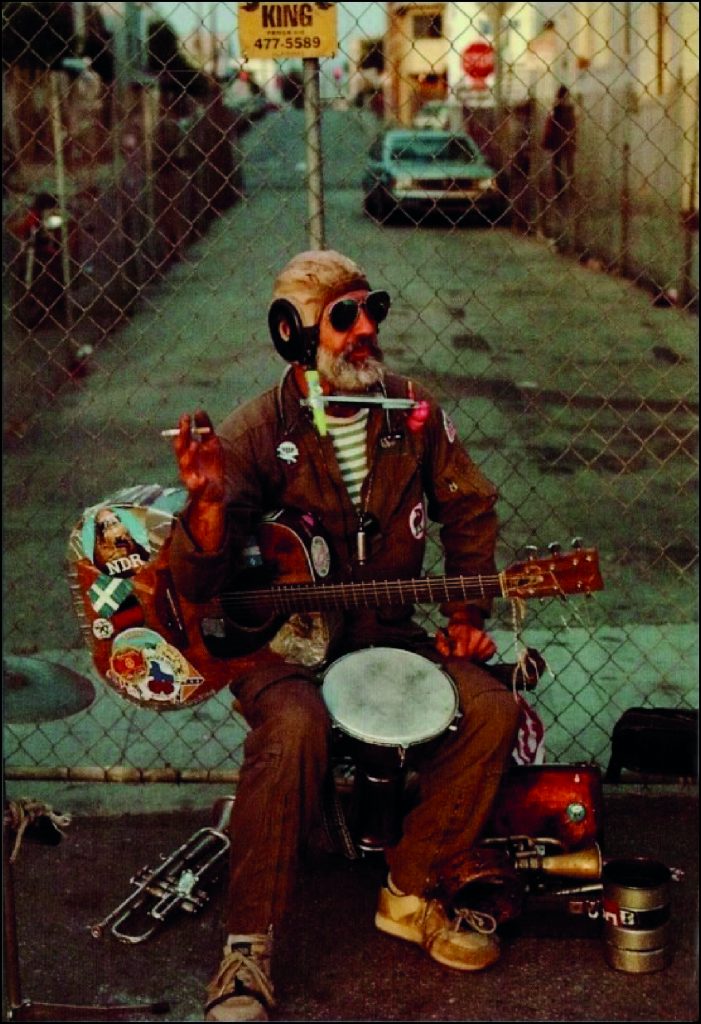
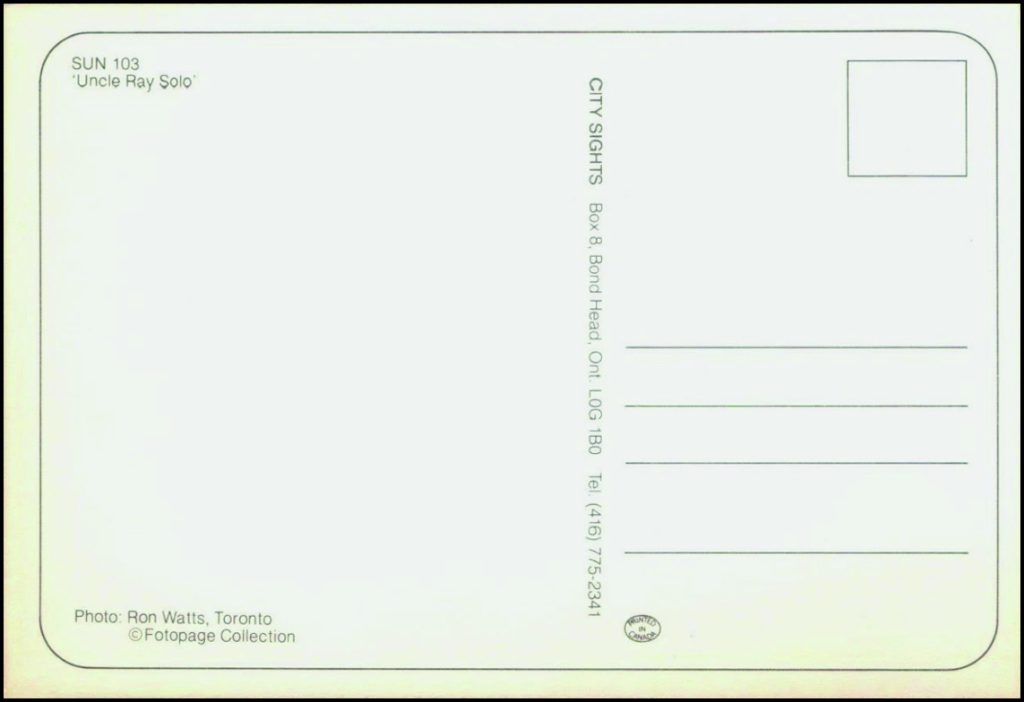
Years later, I came across a postcard of the same man online. This time, he was no longer random figure from my memory, but an image printed for tourists.
eBay had one for sale, just another piece of the past circulating between strangers. I bought it.
Not so much as a souvenir, but as a confirmation.
That the moment in my photograph was not mine alone. That the same man who sat in front of that door, playing his small orchestra, also existed in the eyes of others. That he was distinctive enough to become a postcard. And that, slowly, he had moved from chance into something more permanent.
My photograph, taken on Kodak slide film with a reliable Canon camera, is technically good. But its real value is not in its sharpness or its colors. It lies in the fact that it captured something I didn’t yet know how to recognize.
And that is exactly why I pressed the shutter.
Thank you so much for capturing Uncle Ray Hechim, in a special and historical unique way. He is known as Uncle Ray to many, in spirit, because of their mutual love of music, and his influence reaches many around the world. Thanks for sharing yours with us.