
When one day you decide to go trekking around the Annapurnas. When you have no fitness at all, but you somehow convince yourself it will work. It was back in 2007, when I was younger and believed there were no obstacles under the sky for me.
You start the journey in Besi Sahar and, after two weeks, you crawl (literally) to Jomsom. In between, you spend a day in Manang, visit a hermit in his cave, watch the stars in the night sky. And with difficulty, you crawl over the Thorung-La pass at an altitude of 5,416 meters. You hardly wash, because water is precious. In the morning, you put on the socks with the least unpleasant smell. For breakfast, you order fried eggs — both sides, please.
And then you descend all the way from Thorung_La to Jomsom. A small town with about 1,300 inhabitants. The hostel has hot water. You take a shower, and the world feels like home again.
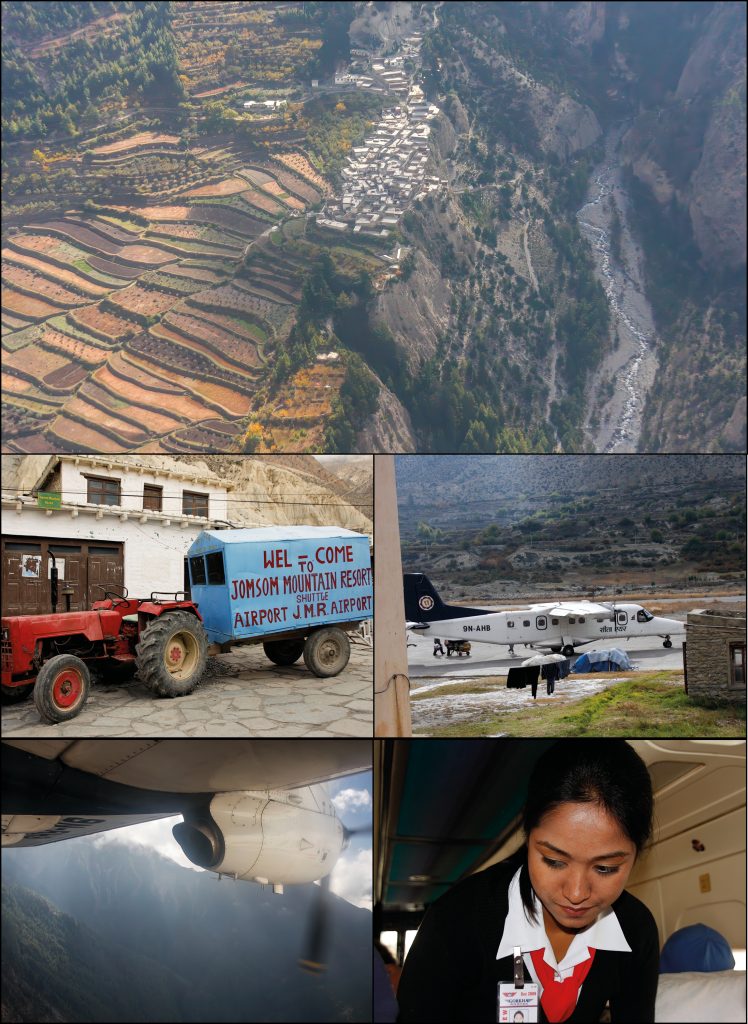
But the adventure is far from over. In the morning, you head to the airport. The airport resides at an elevation of 8,976 feet (2,736 m) above mean sea level. You have your ticket in your pocket, you stand in line, and hope to get a seat on the plane. The first plane arrives from Pokhara at around 8:00 AM. Then another one every half hour — of course, only if there is no wind. In any case, because of the wind, the last plane flies into the valley at around 10:00 AM. If you don’t make it, you simply go back to the hotel and try again the next morning.
The plane is a rugged, German-designed Dornier 228-202K turboprop — one of the few aircraft specifically built to handle the extreme “Short Takeoff and Landing” (STOL) requirements of Nepal’s high-altitude mountain airports. It can land on incredibly short, unpaved, or even grass runways. The airline Gorkha Airlines used it as a regional shuttle. But the airline ceased to operate in 2008.
And while you wait, you watch an incoming plane flying far past the airport. You lose sight of it. After a few minutes, it returns. Since the runway is narrow and short, the plane has to land facing the valley; otherwise, it can’t take off again.
The waiting room is small, and you can stand in line right on the street in front of the airport. Before boarding, there is, of course, a document, ticket, and baggage check. When the policeman reaches into my backpack, I suddenly remember the pocket knife at the bottom. Luckily, he pulls out a slightly larger stone that I picked up as a souvenir at the top of the Thorung-La pass. He is clearly thinking the stone could also be a weapon — and that I might hijack the plane. Logically, Maoist groups were still quite active in the Annapurna area. I explain what the stone means to me, and since I don’t look like a left-wing terrorist, after a minute or so he decides to give it back — and lets me onto the plane.
It’s only a few dozen steps to the aircraft.
I won’t hide the fact that I’m always a little nervous before a flight. I also have a mild form of acrophobia.
I sit in an uncomfortable seat, gripping the armrests. The plane is small, and even the stewardess walks hunched over because the cabin isn’t high enough. She holds a tray with candies. She has already handed out cotton balls to use as earplugs — the engine noise is unbearable. Cotton wool is a classic low-tech solution on these twin-otter-style planes; it helps a bit with the roar and the pressure changes as you navigate the mountain passes.
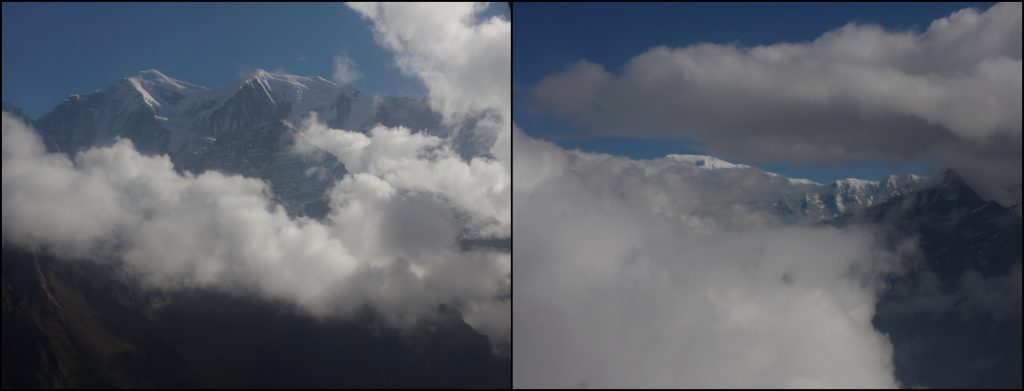
The flight from Jomsom to Pokhara is legendary for being “wild.” Flying through the deep Kali Gandaki gorge, with massive peaks like Dhaulagiri and Annapurna right outside the window, is unforgettable.
And indeed — on the left, the mighty Himalayan range; below, canyons; on the edge of a precipice, a village. One of the most scenic (and bumpy) flights I’ve ever experienced.
When we land in Pokhara after about twenty minutes, I feel infinitely relieved. All that’s left is a transfer to the hotel: hot water, a shower, fresh socks.
In the evening — Tibetan dumplings, momo, mango lassi, and a cold Gorkha beer.
And to end the day: luxury — a bed with cotton sheets.