Part 3: Butter Tea with the Changpa Nomads
I admit that I am quite stubborn by nature. And sometimes I bang my head against a wall. How else can I explain that struggling around Annapurna and over the Thorung La Pass, crossing half the Sahara and climbing high into the mountains of Algeria was still not enough for me? Since they say third time’s the charm, I also set off on a journey through the highlands of the Indian Himalayas, across the passes of Ladakh.
In the middle of summer, because in winter Ladakh is practically cut off from the outside world. Back in 2012, the airport in Leh was surrounded by barbed wire, soldiers and guard towers. You could feel the proximity of Kashmir and the tensions in the region. Quite an unpleasant feeling. Adding to the sense of adventure was the fact that, when applying for an Indian visa, we had been strongly advised not to mention that Ladakh was our actual destination. Whether this was really necessary, I still don’t know. But it certainly added a touch of Indiana Jones to the journey.
A few days of acclimatisation to the altitude really come in handy.
And then, for the next two weeks, you walk up and down. All day, you are alone with nature, rocks and mountains. You almost forget about those friends who are struggling with the next pass just like you. And then, at the end of the trail, not far from Lake Tso Moriri, you meet the Changpa nomads.
The Changpa are semi-nomadic herders. On these plateaus, at altitudes of around 4,000 metres and more, they graze their goats, sheep and yaks.
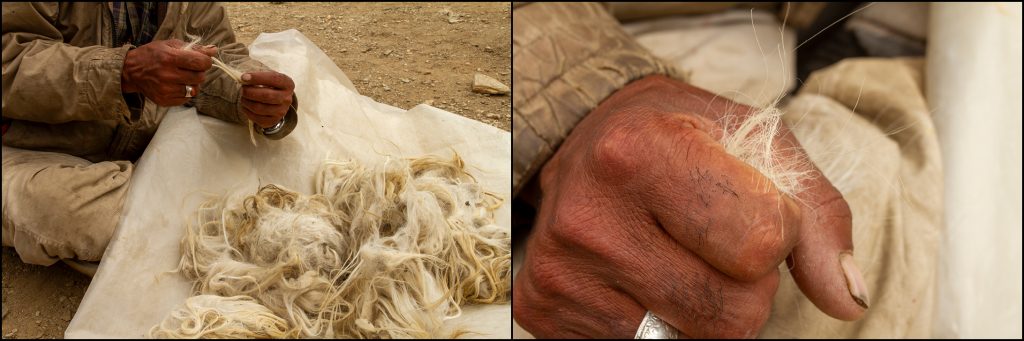
The famous pashmina wool comes from a special breed of goat known as the Changra, closely associated with the Changpa. Living in the harsh, freezing climate, the goats grow a fine, soft undercoat to keep warm. This precious fibre is collected when the goats naturally shed their winter coat.
The winters are long and cold at these altitudes. And what can they offer to make these inhuman conditions a little easier to survive? Along with modest meals and dried meat, they offer you butter tea.
Butter tea is a traditional savoury drink of the Himalayan and Tibetan regions, made with strong tea, butter, water and salt. It tastes more like a light, rich broth than sweet tea and provides welcome warmth and energy at high altitudes.
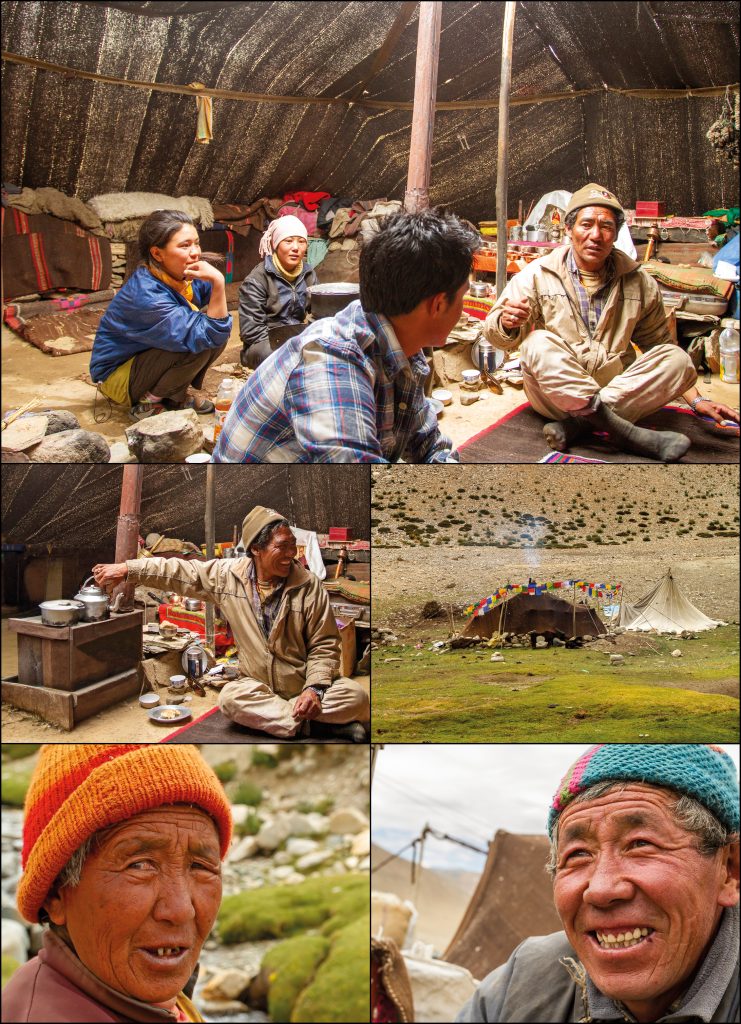
Visitors are rare. So the camp boss invited us into his tent with a broad sweep of his hand. As is customary in these parts, we took off our shoes before entering. The contrast between the muddy, rough surroundings outside and the cleanliness inside the tent was striking. Carpets covered the floor, blankets and personal belongings were arranged around the edges, and a stove stood in the middle, its chimney rising towards the top of the tent. And, of course, the obligatory picture of the Dalai Lama.
The daughters made tea. Their father handed us cups of steaming hot tea. The warmth of the cup in your hands. The butter was supposed to be yak butter, though I strongly suspected it came from goat’s milk. A taste you have to get used to.
As the poet once said—the conversation flowed and the tea flowed… The host with his broken English, us talking with our hands.
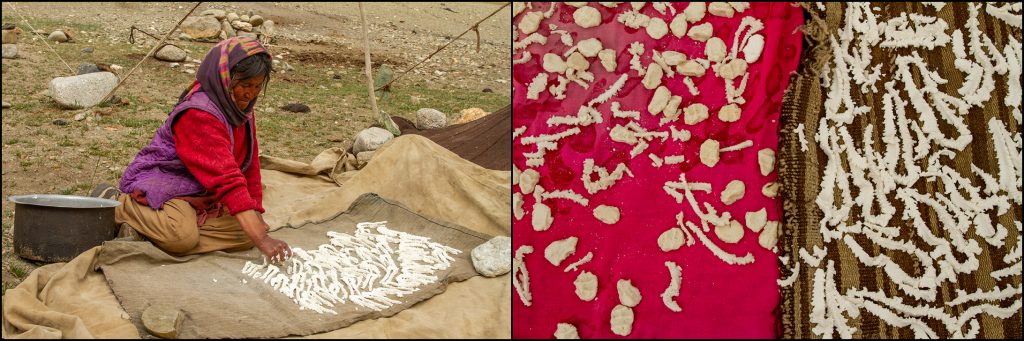
They also offered us their traditional chhurpi cheese. Outside, I saw an older woman squeezing the curd between her fingers, producing something that looked like worms. Then she dried these “worms” in the sun.
The tea was pleasantly fragrant, thick and hot. Having watched how the cheese was made, I took a strip or two with some scepticism and put them in my mouth. Because it is extremely hard, you first have to soften it slowly, letting its flavour gradually emerge as you chew and suck on it. While wondering where exactly you packed those anti-diarrhoea pills, you try to enjoy the experience.
After all, you don’t get an opportunity like this every day.
And then, enriched by another new experience, you head down towards the valley and along the famous Leh–Manali road, back to civilisation.
Whatever that means.