
The Street has always been an intriguing symbol in middleclass American life. It was always the place to avoid. There is “violence in the streets,” “bad people in the streets,” and “danger in the streets.” It was always “let’s keep the kids off the streets” as honkie America rushed from inside to inside. It is in the streets that we will make our struggle. The streets belong to the people! Long live the flower-cong of the gutters!
Abbie Hoffman, Revolution for the Hell of It, 1968
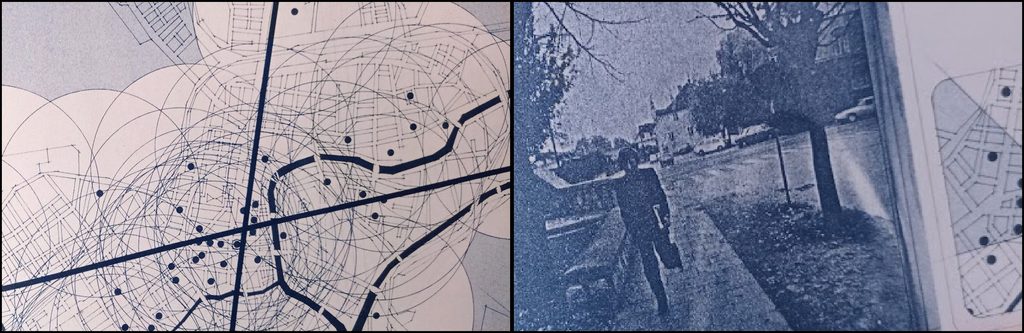
The passage above is a quote from the introduction to my diploma thesis at the Faculty of Architecture—which I defended exactly fifty years ago, in November 1976. A rather bold idea for those times.
Throughout those years, our faculty was known for being quite rebellious—much like the Faculty of Arts, of course, which was located just a stone’s throw away.
The street was always our space of resistance. This dates back to the occupation of Aškerčeva Street in Ljubljana on April 14, 1971—an event considered one of the pivotal moments of the Slovenian student movement in the 1970s. We blocked the road to protest against the unbearable traffic noise that disrupted lectures at the surrounding faculties, as well as against the repressive conduct of the authorities at the time. After all, our faculty was situated on Cojzova Street, an extension of Aškerčeva. Following the events on Aškerčeva Street, tensions between the students and the authorities escalated even further. Another protest rally followed on April 25th, coinciding with a visit by French Prime Minister Jacques Chaban-Delmas; then, in May 1971, the Faculty of Arts was occupied for several days in response to police repression and the arrests of student activists.
Not to mention the time I, along with others, fled from the police—racing across Congress Square (Kongresni trg) and managing to slip through an open door into the University building.
And consider the fact that our faculty had so few Party members that they could barely scrape together a basic cell of the League of Communists of Yugoslavia (ZKJ).
Or the spring we raised such a hue and cry over the routine pruning of trees on Cojzova Street—claiming they were “killing the trees”—and tied red ribbons around them.
And our faculty building, which one summer saw its window frames painted a vivid, wild red—a color that, for the architects of the time, served as a pure aesthetic and modernist manifesto (and later even became a focal point of debate during renovations), yet today triggers entirely different, ideological reflexes in many people.
There was a bit of genuine resistance, a touch of student theater, and a sense of humor.
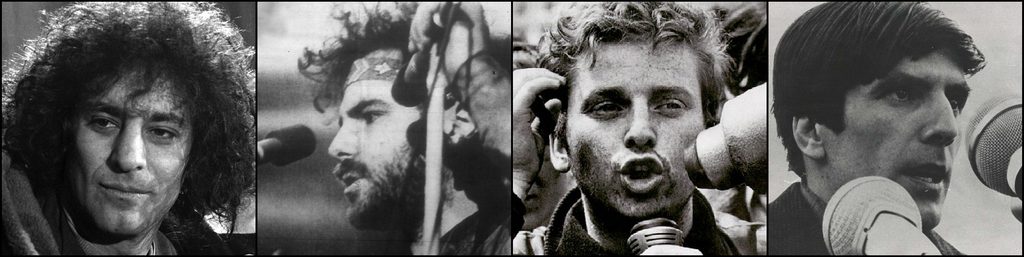
We read Hoffmann, Rubin, Cohn-Bendit, and Rudi Dutschke.
Later on, things faded a bit, softened—but that inner resistance continued to smolder.
And when I was considering a topic for my diploma thesis, the street suddenly emerged as the focal point that drew me in.
I debated all sorts of ideas with a friend—ideas that, to her, seemed a bit “too much.” Things got most complicated when I claimed that I could explore absolutely anything in my thesis—even the design of a woman’s handbag. Alright, I admit I was being a bit provocative, but she took it seriously and looked at me as if I had just dropped from the moon. A future economist, after all…
Well, naturally, I eventually arrived at the topic of urban planning and bicycle paths connecting higher education facilities in the southern part of Ljubljana.
This subject encapsulated the very essence of Hoffman: the street, student protests, the solidarity among students, and bicycles as a symbol of resistance against consumerism and expensive cars.
And so, we return to the Hoffman quote that appeared at the beginning of my thesis. I’m not sure if it was a stroke of luck or not, but since I was the last to present—following a one-hour exposition by Miha Jazbinšek—the committee was already exhausted. They asked me to present only the conclusion of my thesis.
Consequently, that quote by Hoffman went unnoticed.
Later, when I traveled to New York, my sanctuary amidst that wild, pulsating city was always at the same address: 62 St. Mark’s Place in the East Village. There, at the Slovenian Church of St. Cyril, Father Krizolog Cimerman would welcome me with open arms every single time. In that modest church—where the heart of New York’s Slovenian community has beaten for over a century—a completely different world prevailed: a world of peace, the familiar sound of the Slovenian language, coffee, and warm conversations—a true balm after the day-long hustle and bustle of Manhattan.
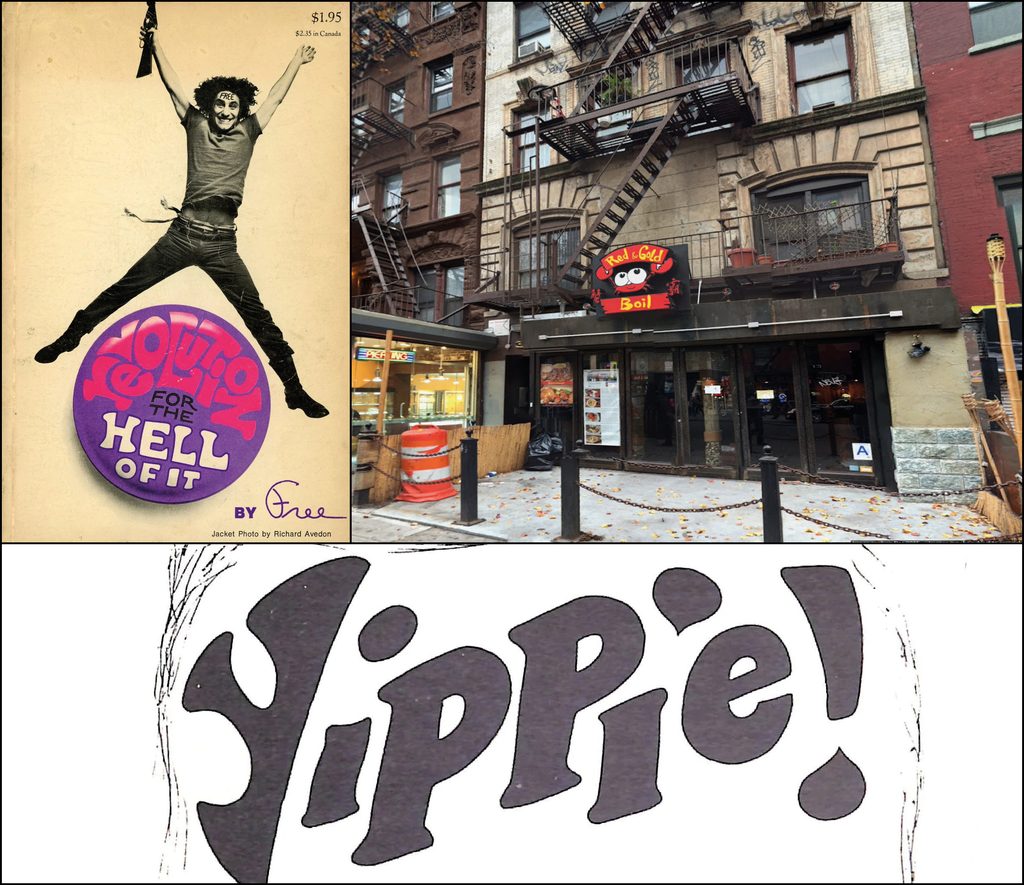
30 St. Marks Place, New York, NY
Yippie movement logo
Only later did I make the connection—a coincidence that feels almost cinematic. Just a few house numbers down the same street, at 30 St. Mark’s Place, the very Abbie Hoffman I had studied lived in a basement apartment during the late 1960s. The street I walked along each morning—on my way from Father Krizolog’s place to pick up a fresh bagel and coffee—was the same street once trodden by the man from my university notes.
St. Mark’s Place has always been a street of striking contrasts. In the late 1960s, Yippies gathered in its basements, plotting to levitate the Pentagon through the power of their minds and to sow confusion among Wall Street stockbrokers using counterfeit banknotes. Just a few dozen meters away, at the Church of St. Cyril, Slovenian immigrants were gathering during that same period—praying in their native tongue and preserving their identity amidst a foreign world.
Today, when I reflect on those times spent in New York, it feels as though an unusual life cycle came full circle somewhere between numbers 30 and 62. The youthful idealism of the 1970s—once captured in the pages of my graduation thesis—found a physical home in my later years: in a neighborhood defined by rebellion, which, for me, offered above all a sense of home and hospitality.
There are over seven million laws in this country. We aim to break every one of them . . . including the law of gravity.
Abbie Hoffman at the Chicago Seven trial, 1969