I know, it’s a somewhat unusual title for an article about cooking. But things become clearer when you realise it’s about pasta e fagioli—and because Dean Martin once sang, “When the stars make you drool, just like pasta fazool, that’s amore.”
Legend has it that the ancient Romans cooked something similar. They loved thick bean soups into which they would break pieces of dough. But take note: Roman pasta e fagioli didn’t contain the kind of beans we know today! They cooked a type of bean known as dolichos (originating from Africa and Asia).
When Spanish explorers brought the beans we know today (such as borlotti and cannellini) from the Americas in the 16th century, a culinary revolution took place. Beans became known as “the poor man’s meat” (la carne dei poveri) because they were a cheap source of protein.
Naturally, Italians claim this dish as their own. But let’s look at the facts. The basic ingredients are pasta and beans. Pasta was supposedly brought to Italy from China by Marco Polo, while Columbus brought beans from the Americas. True, both men were Italian, but… Italians certainly played a major role in the dish’s evolution later on.
Pasta e fagioli is the queen of the so-called cucina povera (peasant cooking). In the past, housewives didn’t buy specific pasta for this dish; they simply used pasta mista—scraps of various pasta shapes that had accumulated at the bottom of boxes throughout the week (a few shells, some broken spaghetti, penne). Rather than using expensive cuts of meat to add flavour, they opted for pork rind (cotica) or cleaned Parmesan rinds.
Emigrants from southern Italy (especially the Naples area) brought the dish to the USA. Due to the Neapolitan dialect (pasta e fasule), the name morphed phonetically in America into “Pasta Fazool.”
Show business personalities helped ensure its global fame—most notably Dean Martin, as mentioned earlier. Frank Sinatra, too, reportedly absolutely adored this dish.
And since Slovenia borders Italy, the dish is quite popular here as well. With one local twist: we like to enhance it with authentic Carniolan sausage (kranjska klobasa).
So, let’s see what we need.
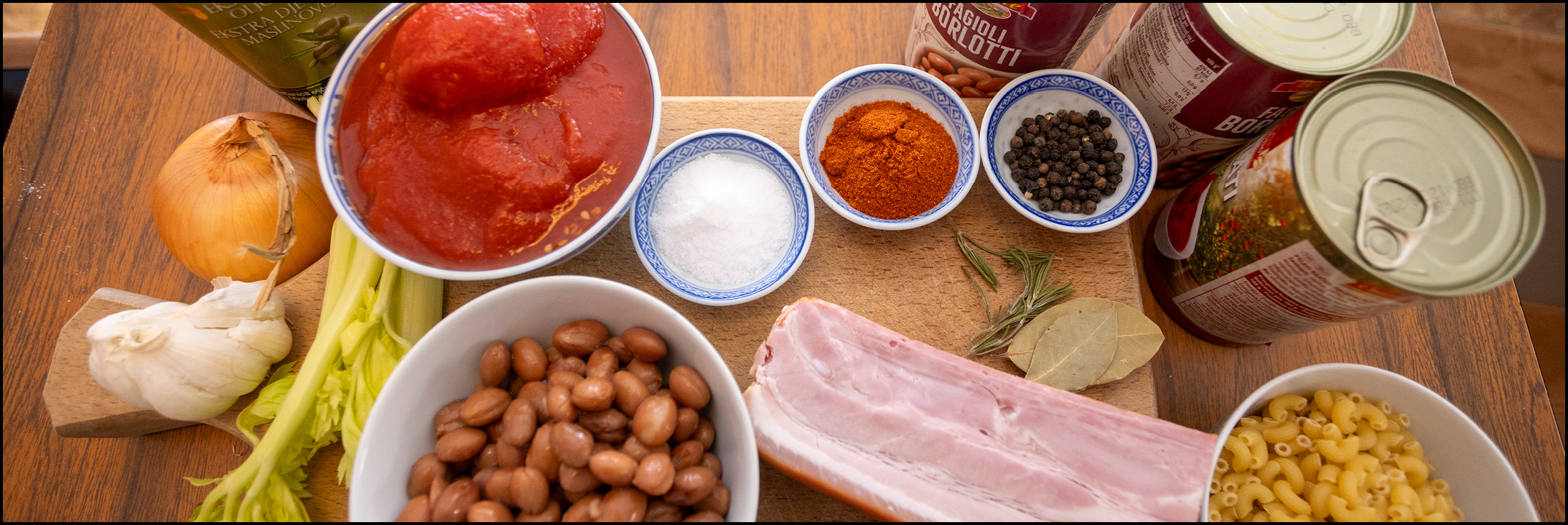
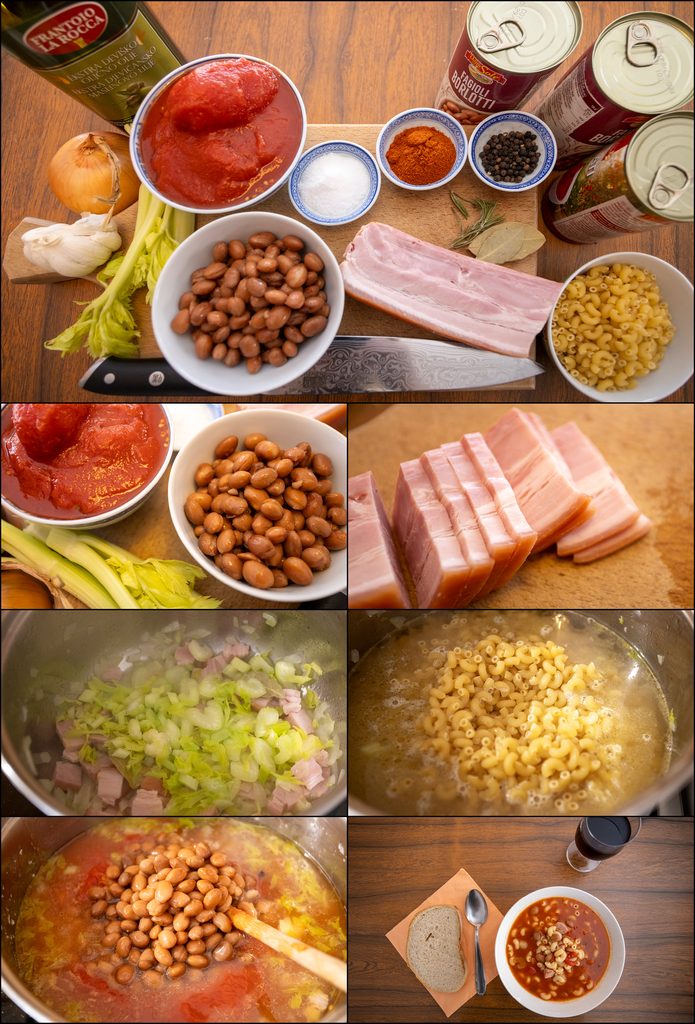
Beans—for the male cooks out there, just buy them pre-cooked in a tin. Small pasta shapes. If you don’t have any, do as Italian women do: wrap larger macaroni in a tea towel, smash it with a hammer, and mind your fingers. Peeled tomatoes (crush them by hand). Onion, garlic, pepper, salt, paprika, rosemary, celery, bay leaf, and olive oil. And, of course, pancetta or meaty bacon. Or, if you’re in Slovenia, Carniolan sausage.
Finely chop the onion and sauté it in oil. Add a crushed clove of garlic. Add the chopped celery. Dice whatever meat you’re using. Add it to the pot and let it brown slightly.
Add the pasta. Pour in enough water to cover the pasta by a few centimetres. Don’t forget that pasta expands during cooking—something to keep in mind when choosing the size of your pot. If you miscalculate, don’t panic; simply deploy a secondary pot onto the stove and pretend you planned it that way all along.
When the pasta is half-cooked, add the beans and tomatoes.
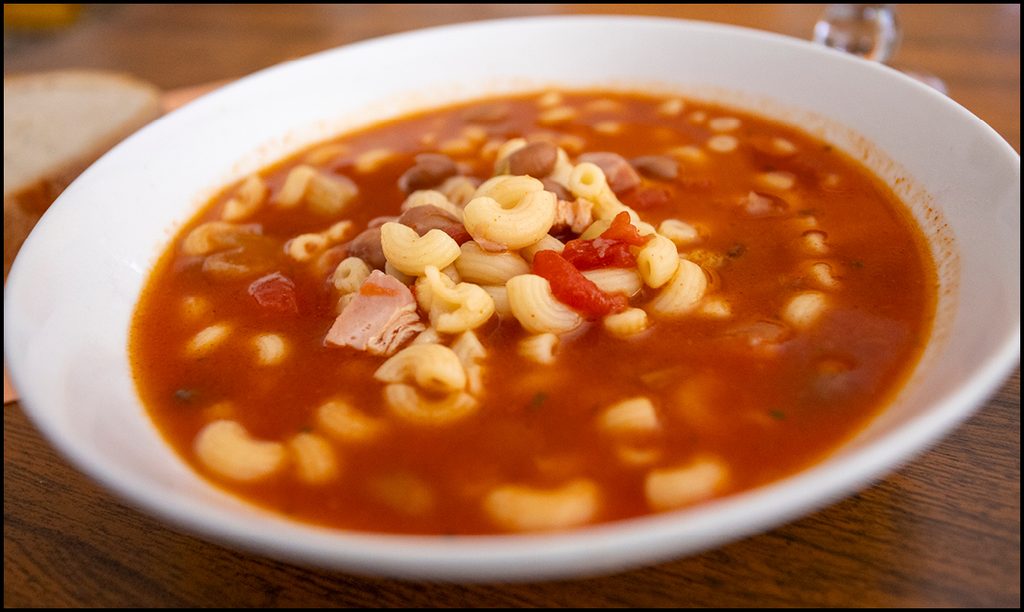
The dish is ready when the pasta is al dente.
You can eat any leftovers the next day; the flavour becomes even richer and fuller. You can also freeze it.
And you will almost certainly have leftovers. Even when I cook it, the pasta expands in a rather mysterious way, and I always end up with double the amount of Pasta e Fagioli.
And last but not least, let your imagination run free.